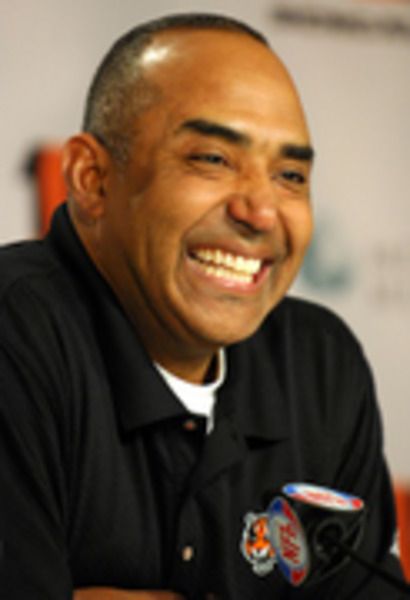
Marvin Lewis
*By Arrangement with Octagon Speakers Group
Marvin Lewis was handed his dream in 2003 when he was named the head coach of the Cincinnati Bengals. The team had not achieved a winning record in 15 seasons and Lewis was called in to revive the franchise. In just three years, Lewis led the team to its first ever AFC North Division championship with an 11-5 record. The team had posted a 2-14 record in 2002 before Lewis arrived, and he is now credited as the instrument to the Bengal's improvement. Lewis also lead the ferocious defensive squad of the Super Bowl Champion Baltimore Ravens as their defensive coordinator in 2000.
"I think we've turned over a new leaf for the Bengals." "We are starting fresh. He has the respect of people throughout the National Football League. He sold us, and I think he will sell the people in Cincinnati." - Mike Brown, Owner of the Cincinnati Bengals
Marvin Lewis (born September 23, 1958 in McDonald, Pennsylvania) is the head coach of the National Football League's Cincinnati Bengals franchise, a position he has held since since January, 2003.
Lewis is credited as being instrumental in the Bengals' improvement. Before his arrival, the team had experienced just one non-losing season in fifteen previous seasons. Indeed, he is the only coach in team history to not have a losing record.
He grew up in suburban Pittsburgh and attended Fort Cherry High School. He was a notable quarterback and safety.
After graduating high school, Marvin Lewis attended the Division I-AA Idaho State University in Pocatello, Idaho. On the Idaho State football team, he played linebacker as well as quarterback and free safety. In a coincidence foreshadowing his future role in the National Football League, Idaho State's athletic teams are known as the Bengals. Lewis earned All-Big Sky Conference honors as a linebacker in 1978, 1979 and 1980. After not being drafted in the NFL, Lewis decided to become the ISU Bengals' linebacker coach rather than attempt to sign with a team as a non-drafted player.
Academically, Lewis earned his Bachelor of Arts degree in physical education in 1981 and a Master of Physical Education degree in athletic administration in 1982. He was inducted into the Idaho State University Sports Hall of Fame in 2001.
In 1984 Lewis left Idaho State and became linebacker coach at Long Beach State University. He later held coaching positions at the University of New Mexico and the University of Pittsburgh.
In 1992, Marvin Lewis was hired by the NFL's Pittsburgh Steelers as linebackers coach. It was his first job in the professional ranks, and Lewis was with the organization until he was hired as the defensive coordinator for the Baltimore Ravens in 1996. In 2000, the Ravens won the Super Bowl, defeating the New York Giants 34-7. His defensive squad, led by Pro Bowl linebacker Ray Lewis (no relation) set several NFL regular season records, including recording four shutouts, allowing the fewest rushing yards (970) and the fewest points (165) in a 16-game season. Lewis' reputation as a defensive genius and a rising star among the ranks of the NFL's assistant coaches was solidified by the dominating performance of the Ravens.
In 2002, Lewis was hired as the Washington Redskins' defensive coordinator and was with the team one year.
In 2003, Lewis was hired as head coach by the Cincinnati Bengals, a beleaguered franchise that had not made the playoffs or recorded a winning record since the 1990 season and had a 2-14 record the previous season, the worst performance in team history. Moreover, Cincinnati was viewed by many as the Siberia of the NFL and was beset by legal problems over their new facility, Paul Brown Stadium, and the Bengals' majority owner, Mike Brown, the son of the Bengals' legendary founder and first coach, Paul Brown, was excoriated by the fans for incompetence.
The Bengals started Lewis' rookie season 1-4, and it looked like they were heading for yet another miserable year, but they recovered and finished the year with a respectable 8-8 record. One key reason was the re-emergence of veteran quarterback Jon Kitna, the former Seattle Seahawks signalcaller who signed with the Bengals in 2001. Kitna threw for over 3,500 yards, 26 touchdown passes, and won the NFL's Comeback Player of the Year award.
However, the consensus opinion among fans and pundits was that Carson Palmer, the Bengals' Heisman Trophy-winning number one draft pick out of USC in 2003 would be the starter in 2004. Palmer did not play a single down in the regular season; Kitna, in fact, took every single snap. That opinion became fact when, before training camp, Palmer was named the #1 quarterback. However, the team was plagued with injuries and difficulty in getting used to a new quarterback. Once again the team started the season with a 1-4 record. Lewis' choice to start Palmer seemed like it might have been a bad one, but, as they had done the previous season, the Bengals recovered and finished the season with an identical 8-8 record.
In 2005, the Bengals won the AFC North division with an 11-5 record, ending a league-high fifteen-year streak of futility. Palmer led the NFL in completion percentage, threw for 3,836 yards, set a franchise record with 32 touchdown passes, and made the Pro Bowl. Running back Rudi Johnson and receiver Chad Johnson set new team marks in rushing and reception yardage, respectively.
However, in the 2005 AFC Wild Card game against the rival Pittsburgh Steelers on January 8, 2005, Palmer suffered a devastating knee injury on the second offensive play: a 66-yard strike to receiver Chris Henry, who suffered a comparatively minor knee injury himself on the play. Kitna replaced Palmer, but the Bengals were unable to contain the Steelers, who won 31-17 and eventually won Super Bowl XL.
Currently, Lewis is one of seven black head coaches in the National Football League. The others are Art Shell (Oakland Raiders), Romeo Crennel (Cleveland Browns), Tony Dungy (Indianapolis Colts), Herman Edwards (Kansas City Chiefs), Dennis Green (Arizona Cardinals), and Lovie Smith (Chicago Bears).
Since August, 2002, Marvin Lewis has also been affectionately referred to as "Black Jesus" by Bengals players and fans. "No sacrilege intended, but he is resurrecting this franchise," said former Bengal and present New England Patriots cornerback Artrell Hawkins in 2003. This name has garnered some national recognition and ESPN The Magazine in a January, 2005 article by writer Tom Friend even referred to him, not by his given name, but as "Black Jesus". In that same article, former Bengals running back Corey Dillon said, "You've got your Black Jesus, I'm your Judas, why hold me hostage? Set me free."
However, Lewis has been quick to deflect any such praise.
Lewis is married to Peggy Lewis and has two children, Whitney and Marcus.
*By Arrangement with Octagon Speakers Group
Marvin Lewis was handed his dream in 2003 when he was named the head coach of the Cincinnati Bengals. The team had not achieved a winning record in 15 seasons and Lewis was called in to revive the franchise. In just three years, Lewis led the team to its first ever AFC North Division championship with an 11-5 record. The team had posted a 2-14 record in 2002 before Lewis arrived, and he is now credited as the instrument to the Bengal's improvement. Lewis also lead the ferocious defensive squad of the Super Bowl Champion Baltimore Ravens as their defensive coordinator in 2000.
"I think we've turned over a new leaf for the Bengals." "We are starting fresh. He has the respect of people throughout the National Football League. He sold us, and I think he will sell the people in Cincinnati." - Mike Brown, Owner of the Cincinnati Bengals
Marvin Lewis (born September 23, 1958 in McDonald, Pennsylvania) is the head coach of the National Football League's Cincinnati Bengals franchise, a position he has held since since January, 2003.
Lewis is credited as being instrumental in the Bengals' improvement. Before his arrival, the team had experienced just one non-losing season in fifteen previous seasons. Indeed, he is the only coach in team history to not have a losing record.
He grew up in suburban Pittsburgh and attended Fort Cherry High School. He was a notable quarterback and safety.
After graduating high school, Marvin Lewis attended the Division I-AA Idaho State University in Pocatello, Idaho. On the Idaho State football team, he played linebacker as well as quarterback and free safety. In a coincidence foreshadowing his future role in the National Football League, Idaho State's athletic teams are known as the Bengals. Lewis earned All-Big Sky Conference honors as a linebacker in 1978, 1979 and 1980. After not being drafted in the NFL, Lewis decided to become the ISU Bengals' linebacker coach rather than attempt to sign with a team as a non-drafted player.
Academically, Lewis earned his Bachelor of Arts degree in physical education in 1981 and a Master of Physical Education degree in athletic administration in 1982. He was inducted into the Idaho State University Sports Hall of Fame in 2001.
In 1984 Lewis left Idaho State and became linebacker coach at Long Beach State University. He later held coaching positions at the University of New Mexico and the University of Pittsburgh.
In 1992, Marvin Lewis was hired by the NFL's Pittsburgh Steelers as linebackers coach. It was his first job in the professional ranks, and Lewis was with the organization until he was hired as the defensive coordinator for the Baltimore Ravens in 1996. In 2000, the Ravens won the Super Bowl, defeating the New York Giants 34-7. His defensive squad, led by Pro Bowl linebacker Ray Lewis (no relation) set several NFL regular season records, including recording four shutouts, allowing the fewest rushing yards (970) and the fewest points (165) in a 16-game season. Lewis' reputation as a defensive genius and a rising star among the ranks of the NFL's assistant coaches was solidified by the dominating performance of the Ravens.
In 2002, Lewis was hired as the Washington Redskins' defensive coordinator and was with the team one year.
In 2003, Lewis was hired as head coach by the Cincinnati Bengals, a beleaguered franchise that had not made the playoffs or recorded a winning record since the 1990 season and had a 2-14 record the previous season, the worst performance in team history. Moreover, Cincinnati was viewed by many as the Siberia of the NFL and was beset by legal problems over their new facility, Paul Brown Stadium, and the Bengals' majority owner, Mike Brown, the son of the Bengals' legendary founder and first coach, Paul Brown, was excoriated by the fans for incompetence.
The Bengals started Lewis' rookie season 1-4, and it looked like they were heading for yet another miserable year, but they recovered and finished the year with a respectable 8-8 record. One key reason was the re-emergence of veteran quarterback Jon Kitna, the former Seattle Seahawks signalcaller who signed with the Bengals in 2001. Kitna threw for over 3,500 yards, 26 touchdown passes, and won the NFL's Comeback Player of the Year award.
However, the consensus opinion among fans and pundits was that Carson Palmer, the Bengals' Heisman Trophy-winning number one draft pick out of USC in 2003 would be the starter in 2004. Palmer did not play a single down in the regular season; Kitna, in fact, took every single snap. That opinion became fact when, before training camp, Palmer was named the #1 quarterback. However, the team was plagued with injuries and difficulty in getting used to a new quarterback. Once again the team started the season with a 1-4 record. Lewis' choice to start Palmer seemed like it might have been a bad one, but, as they had done the previous season, the Bengals recovered and finished the season with an identical 8-8 record.
In 2005, the Bengals won the AFC North division with an 11-5 record, ending a league-high fifteen-year streak of futility. Palmer led the NFL in completion percentage, threw for 3,836 yards, set a franchise record with 32 touchdown passes, and made the Pro Bowl. Running back Rudi Johnson and receiver Chad Johnson set new team marks in rushing and reception yardage, respectively.
However, in the 2005 AFC Wild Card game against the rival Pittsburgh Steelers on January 8, 2005, Palmer suffered a devastating knee injury on the second offensive play: a 66-yard strike to receiver Chris Henry, who suffered a comparatively minor knee injury himself on the play. Kitna replaced Palmer, but the Bengals were unable to contain the Steelers, who won 31-17 and eventually won Super Bowl XL.
Currently, Lewis is one of seven black head coaches in the National Football League. The others are Art Shell (Oakland Raiders), Romeo Crennel (Cleveland Browns), Tony Dungy (Indianapolis Colts), Herman Edwards (Kansas City Chiefs), Dennis Green (Arizona Cardinals), and Lovie Smith (Chicago Bears).
Since August, 2002, Marvin Lewis has also been affectionately referred to as "Black Jesus" by Bengals players and fans. "No sacrilege intended, but he is resurrecting this franchise," said former Bengal and present New England Patriots cornerback Artrell Hawkins in 2003. This name has garnered some national recognition and ESPN The Magazine in a January, 2005 article by writer Tom Friend even referred to him, not by his given name, but as "Black Jesus". In that same article, former Bengals running back Corey Dillon said, "You've got your Black Jesus, I'm your Judas, why hold me hostage? Set me free."
However, Lewis has been quick to deflect any such praise.
Lewis is married to Peggy Lewis and has two children, Whitney and Marcus.