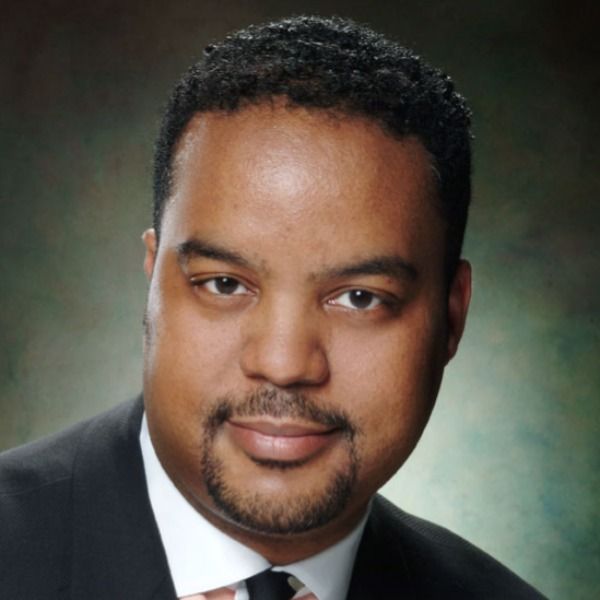
Michael K. Fauntroy
Ph.D.
DC, USMichael K. Fauntroy, Ph.D. is an assistant professor of public policy at George Mason University (GMU), where he teaches courses in urban policy and American government and conducts research at the intersection of race and American politics. Prior to joining the faculty at GMU, he was an analyst in American national government at the Congressional Research Service (CRS). At CRS, he provided research and consultations for members and committees of Congress. From 1993 to 1996, he was a civil rights analyst at the U.S. Commission on Civil Rights, where he conducted research on major civil rights issues.
Fauntroy's new book, Republicans and the Black Vote (2007), analyzes the historical relationship between African Americans and the GOP. He is also the author of Home Rule or House Rule? Congress and the Erosion of Local Governance in the District of Columbia (2003). He is currently writing a book on the evolution of federal civil rights enforcement.
His media reach is extensive. He has been published or quoted in newspapers throughout America and is a weekly contributor to "The Cliff Kelley Show" on WVON-AM in Chicago. His political analysis also has been broadcast on national radio and television networks such as ABC News, CNN, MSNBC, Syndication One, Comcast, Radio One, the British Broadcasting Corporation, the Canadian Broadcasting Corporation, National Public Radio, Pacifica Radio, and XM Satellite Radio. He also has appeared on local radio and television stations in Atlanta, Georgia; Chicago, Illinois; Denver, Colorado; Detroit, Michigan; Houston, Texas; St. Louis, Missouri; Tampa, Florida; and Washington, D.C.
Programs:(1) Republicans and the Black Vote: How Did the Disconnect Happen? Explains how the Republican Party went from near unanimous support in the Black community during Reconstruction to near total opposition today.
(2) The State of Black America: Progress and Setbacks for Black America. This program takes a long historical view of the political, economic, and cultural strengths and weaknesses within the Black community and what that means for the country going forward.
(3) The Contemporary Political Landscape: What’s Happening and Why? An overview of national politics from Congress to the White House. This program examines contemporary legislation, elections, and why they are important.
(4) The Effort to Destroy Black Voting Rights. Examines and explains examples of voter disenfranchisement laws and other mechanisms to undermine African American voting and prevent votes from being counted in elections around the country.
(5) Social Consciousness in a World of Apathy. This program traces the rise and fall of social consciousness in America along with increasing political, social, and cultural apathy.
(6) The Arithmetic of Black Political Power. This program discusses the disproportionate impact African Americans can have in American politics given their concentration in small, but important parts of the country.
Michael K. Fauntroy, Ph.D. is an assistant professor of public policy at George Mason University (GMU), where he teaches courses in urban policy and American government and conducts research at the intersection of race and American politics. Prior to joining the faculty at GMU, he was an analyst in American national government at the Congressional Research Service (CRS). At CRS, he provided research and consultations for members and committees of Congress. From 1993 to 1996, he was a civil rights analyst at the U.S. Commission on Civil Rights, where he conducted research on major civil rights issues.
Fauntroy's new book, Republicans and the Black Vote (2007), analyzes the historical relationship between African Americans and the GOP. He is also the author of Home Rule or House Rule? Congress and the Erosion of Local Governance in the District of Columbia (2003). He is currently writing a book on the evolution of federal civil rights enforcement.
His media reach is extensive. He has been published or quoted in newspapers throughout America and is a weekly contributor to "The Cliff Kelley Show" on WVON-AM in Chicago. His political analysis also has been broadcast on national radio and television networks such as ABC News, CNN, MSNBC, Syndication One, Comcast, Radio One, the British Broadcasting Corporation, the Canadian Broadcasting Corporation, National Public Radio, Pacifica Radio, and XM Satellite Radio. He also has appeared on local radio and television stations in Atlanta, Georgia; Chicago, Illinois; Denver, Colorado; Detroit, Michigan; Houston, Texas; St. Louis, Missouri; Tampa, Florida; and Washington, D.C.
Programs:(1) Republicans and the Black Vote: How Did the Disconnect Happen? Explains how the Republican Party went from near unanimous support in the Black community during Reconstruction to near total opposition today.
(2) The State of Black America: Progress and Setbacks for Black America. This program takes a long historical view of the political, economic, and cultural strengths and weaknesses within the Black community and what that means for the country going forward.
(3) The Contemporary Political Landscape: What’s Happening and Why? An overview of national politics from Congress to the White House. This program examines contemporary legislation, elections, and why they are important.
(4) The Effort to Destroy Black Voting Rights. Examines and explains examples of voter disenfranchisement laws and other mechanisms to undermine African American voting and prevent votes from being counted in elections around the country.
(5) Social Consciousness in a World of Apathy. This program traces the rise and fall of social consciousness in America along with increasing political, social, and cultural apathy.
(6) The Arithmetic of Black Political Power. This program discusses the disproportionate impact African Americans can have in American politics given their concentration in small, but important parts of the country.