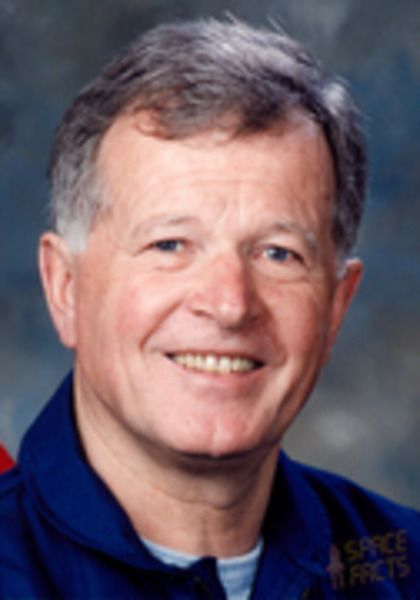
Jean Loup Chretien
During a fulfilling career, Jean-Loup Chretien has become a veteran of three space flights (Soyuz T-6, Soyuz TM, and STS-86) and accumulated over 8,000 hours of flying time in various aircraft, including Russia's Tupolev 154, MIG 25, and Sukoi 26 and 27. Ultimately becoming the 10th Intercosmos cosmonaut, the first non-American and non-Soviet cosmonaut to walk in space and the first non-Soviet cosmonaut to make a second space flight aboard a Soviet spacecraft. In total he has spent 43 days, 11 hours, 18 minutes, 42 seconds in space, including an EVA of 5 hours, 57 minutes.
As a visionary, Chretien speaks on the future of space exploration, international teaming and cooperation. Born August 20, 1938, in the town of La Rochelle, France, Chretien is fluent in both the English and Russian languages. He entered L'Ecole de l' Air (the French Air Force Academy) at Salon de Provence in 1959, and graduated in 1961, receiving a master's degree in aeronautical engineering.
Chretien received his fighter pilot/pilot-engineer wings in 1962, after one year of training on Mystere-4's. He was then promoted to Lieutenant, and joined the 5th Fighter Squadron in Orange, in the Southeast of France, where he served for seven years as a fighter pilot in an operational squadron flying Super-Mystere B2's and then Mirage III interceptors. In 1970, he was assigned to the French test pilots school, where he served as a test pilot at the Istres Flight Test Center for seven years. In 1977-78, he was appointed Deputy Commander of the South Air Defense Division in Aix en Provence.
In April 1979, the Soviet Union offered France the opportunity to fly a cosmonaut on board a joint Soviet-French space flight. In 1981, Chretien was named as the research-cosmonaut for the prime crew of the Soyuz T-6 mission.
Soyuz T-6 was launched on June 24, 1982. They spent nearly seven days carrying out a program of joint Soviet-French experiments, before returning to Earth after a flight lasting 7 days, 21 hours, 50 minutes, 42 seconds. This flight made him the first Western non-American, as well as the first Western European to go to space.
Chretien made his second space flight as a research-cosmonaut on board Soyuz TM-7, which launched on November 26, 1988. They spent 22 days carrying out a program of joint Soviet-French experiments, including a 5 hour 57 minute EVA. The mission lasted 24 days, 18 hours, 7 minutes.
Finally, selected as a NASA astronaut, Chretien attended ASCAN Training at the Johnson Space Center during 1995. He was selected to serve on the crew of STS-86, the seventh mission to rendezvous and dock with the Russian Space Station Mir from September 25 to October 6, 1997.
Chretien retired from NASA in 2001 and has shifted his focus to developing a business and speaking career.
During a fulfilling career, Jean-Loup Chretien has become a veteran of three space flights (Soyuz T-6, Soyuz TM, and STS-86) and accumulated over 8,000 hours of flying time in various aircraft, including Russia's Tupolev 154, MIG 25, and Sukoi 26 and 27. Ultimately becoming the 10th Intercosmos cosmonaut, the first non-American and non-Soviet cosmonaut to walk in space and the first non-Soviet cosmonaut to make a second space flight aboard a Soviet spacecraft. In total he has spent 43 days, 11 hours, 18 minutes, 42 seconds in space, including an EVA of 5 hours, 57 minutes.
As a visionary, Chretien speaks on the future of space exploration, international teaming and cooperation. Born August 20, 1938, in the town of La Rochelle, France, Chretien is fluent in both the English and Russian languages. He entered L'Ecole de l' Air (the French Air Force Academy) at Salon de Provence in 1959, and graduated in 1961, receiving a master's degree in aeronautical engineering.
Chretien received his fighter pilot/pilot-engineer wings in 1962, after one year of training on Mystere-4's. He was then promoted to Lieutenant, and joined the 5th Fighter Squadron in Orange, in the Southeast of France, where he served for seven years as a fighter pilot in an operational squadron flying Super-Mystere B2's and then Mirage III interceptors. In 1970, he was assigned to the French test pilots school, where he served as a test pilot at the Istres Flight Test Center for seven years. In 1977-78, he was appointed Deputy Commander of the South Air Defense Division in Aix en Provence.
In April 1979, the Soviet Union offered France the opportunity to fly a cosmonaut on board a joint Soviet-French space flight. In 1981, Chretien was named as the research-cosmonaut for the prime crew of the Soyuz T-6 mission.
Soyuz T-6 was launched on June 24, 1982. They spent nearly seven days carrying out a program of joint Soviet-French experiments, before returning to Earth after a flight lasting 7 days, 21 hours, 50 minutes, 42 seconds. This flight made him the first Western non-American, as well as the first Western European to go to space.
Chretien made his second space flight as a research-cosmonaut on board Soyuz TM-7, which launched on November 26, 1988. They spent 22 days carrying out a program of joint Soviet-French experiments, including a 5 hour 57 minute EVA. The mission lasted 24 days, 18 hours, 7 minutes.
Finally, selected as a NASA astronaut, Chretien attended ASCAN Training at the Johnson Space Center during 1995. He was selected to serve on the crew of STS-86, the seventh mission to rendezvous and dock with the Russian Space Station Mir from September 25 to October 6, 1997.
Chretien retired from NASA in 2001 and has shifted his focus to developing a business and speaking career.