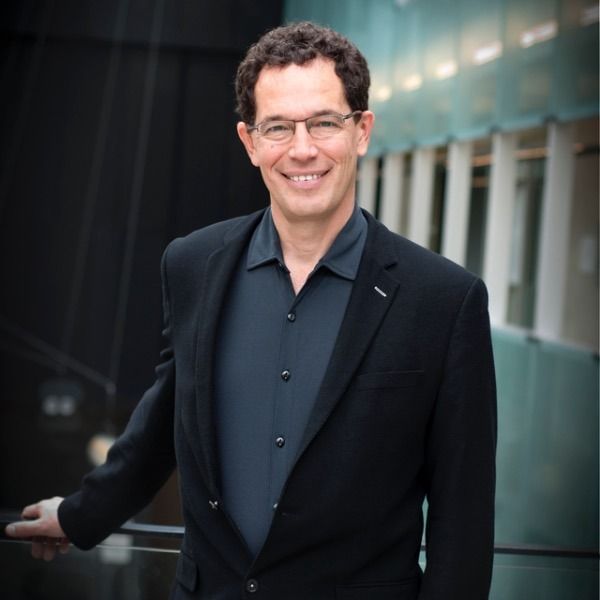
Neil Turok
With Stephen Hawking, he developed the Hawking-Turok instanton solutions, describing the birth of an inflationary universe — positing that, big bang or no, the universe came from something, not from utter nothingness.
Recently, with Paul Steinhardt at Princeton, Turok has been working on a cyclic model for the universe in which the big bang is explained as a collision between two brane-worlds. The two physicists recently co-wrote the popular-science book Endless Universe.
In 2003, Turok, who was born in South Africa, founded the African Institute for Mathematical Sciences (AIMS) in Muizenberg, a postgraduate center supporting math and science. His TED Prize wish: Help him grow AIMS and promote the study and math and science in Africa, so that the world's next Einstein may be African.
Turok is the Director of the Perimeter Institute for Theoretical Physics, in Ontario, Canada. In 2010, the Canadian government funded a $20million expansion of the AIMS schools, working with the Perimeter Institute to start five new AIMS schools in different African nations.
In 2016, he won the Tate Medal for International Leadership in Physics.
With Stephen Hawking, he developed the Hawking-Turok instanton solutions, describing the birth of an inflationary universe — positing that, big bang or no, the universe came from something, not from utter nothingness.
Recently, with Paul Steinhardt at Princeton, Turok has been working on a cyclic model for the universe in which the big bang is explained as a collision between two brane-worlds. The two physicists recently co-wrote the popular-science book Endless Universe.
In 2003, Turok, who was born in South Africa, founded the African Institute for Mathematical Sciences (AIMS) in Muizenberg, a postgraduate center supporting math and science. His TED Prize wish: Help him grow AIMS and promote the study and math and science in Africa, so that the world's next Einstein may be African.
Turok is the Director of the Perimeter Institute for Theoretical Physics, in Ontario, Canada. In 2010, the Canadian government funded a $20million expansion of the AIMS schools, working with the Perimeter Institute to start five new AIMS schools in different African nations.
In 2016, he won the Tate Medal for International Leadership in Physics.
Covers & Jackets