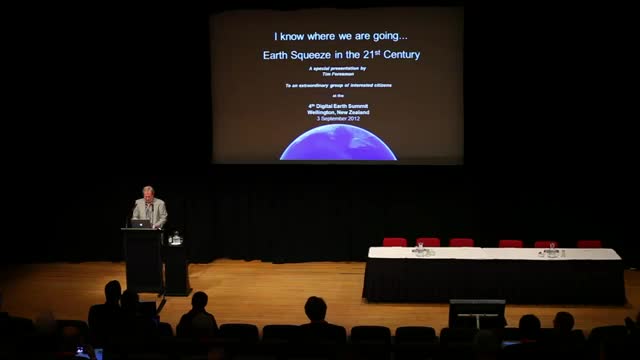
Tim Foresman
Tim Foresman is a leading authority on reading the vital signs of our warming planet. As Co-Principal Investigator for the National Science Foundation's Long-Term Ecosystem Monitoring Program in the mid-1990s, he detailed the scientific evidence for climate change. At NASA Headquarters, he worked to create accurate projections of the local and regional impacts of global warming. He was tapped by the United Nations Environment Programme to serve as its Director of Early Warning and Assessment and Executive Science Advisor.
Long focused on the fate of the world's waters, Foresman launched the Global Marine Monitoring initiative at the UN and headed Global Water, a technology clearinghouse supporting a sustainable water supply. He researched pollution control methods at the U.S. Naval Civil Engineering Laboratory and inspired the award-winning PBS film, The Whales That Wouldn't Die, through his work to define critical habitat for grey whales.
While at NASA, Foresman spearheaded the Digital Earth Initiative, an information-sharing compact that paved the way for such applications as Google Earth. He is a founder of the International Society for Digital Earth and founder and President of the International Center for Remote Sensing Education, a non-profit devoted to harnessing technology to shape policy and inform the public.
In prior roles with government agencies at all levels, Foresman did groundbreaking work in developing geographic information systems to map the resources and sensitivities of regions from the deserts of Nevada to the arctic tundra. He was instrumental in creation of the Arctic Portal (hosted by the Environmental Information Coalition of the National Center for Science and the Environment).
Foresman is the author of The History Of Geographic Information Systems, the definitive text in the field, as well as of almost 100 technical articles and a children's book, The Last Little Polar Bear: A Global Change Adventure Story.
Tim Foresman speaks on Earth monitoring, remote sensing, climate change, ocean protection and conservation, whales and marine mammals, water supply and conservation, and how technology arms us with information for action against climate change and its effects on land and sea.
Tim Foresman is a leading authority on reading the vital signs of our warming planet. As Co-Principal Investigator for the National Science Foundation's Long-Term Ecosystem Monitoring Program in the mid-1990s, he detailed the scientific evidence for climate change. At NASA Headquarters, he worked to create accurate projections of the local and regional impacts of global warming. He was tapped by the United Nations Environment Programme to serve as its Director of Early Warning and Assessment and Executive Science Advisor.
Long focused on the fate of the world's waters, Foresman launched the Global Marine Monitoring initiative at the UN and headed Global Water, a technology clearinghouse supporting a sustainable water supply. He researched pollution control methods at the U.S. Naval Civil Engineering Laboratory and inspired the award-winning PBS film, The Whales That Wouldn't Die, through his work to define critical habitat for grey whales.
While at NASA, Foresman spearheaded the Digital Earth Initiative, an information-sharing compact that paved the way for such applications as Google Earth. He is a founder of the International Society for Digital Earth and founder and President of the International Center for Remote Sensing Education, a non-profit devoted to harnessing technology to shape policy and inform the public.
In prior roles with government agencies at all levels, Foresman did groundbreaking work in developing geographic information systems to map the resources and sensitivities of regions from the deserts of Nevada to the arctic tundra. He was instrumental in creation of the Arctic Portal (hosted by the Environmental Information Coalition of the National Center for Science and the Environment).
Foresman is the author of The History Of Geographic Information Systems, the definitive text in the field, as well as of almost 100 technical articles and a children's book, The Last Little Polar Bear: A Global Change Adventure Story.
Tim Foresman speaks on Earth monitoring, remote sensing, climate change, ocean protection and conservation, whales and marine mammals, water supply and conservation, and how technology arms us with information for action against climate change and its effects on land and sea.
Climate Change Science and Understanding
Polar Bears and Climate Change
Sustainability and Climate Change
The Global Environment-View from the Summit
Ocean World
STEM Education Making It Real
Google Earth Technology
Citizen Scientists and Social Media