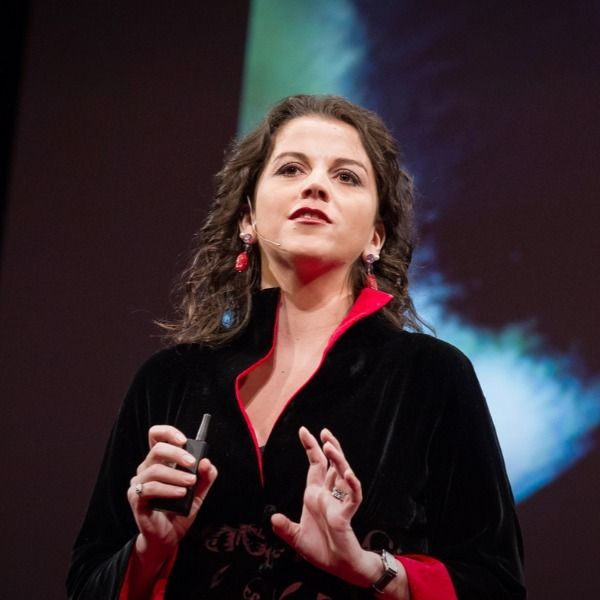
Isabel Behncke Izquierdo
Isabel Behncke is a primatologist currently completing her doctoral work at Oxford University. The aim of her work is to discover how can our evolutionary past help us understand human social behaviour – and how can we apply this knowledge to improve human well being. She is particularly interested in the mechanisms that underlie the ability to adapt to an ever-changing world, and in particular the role of relationships in this process. Her more recent project involved studying the social behaviour of a community of wild bonobos for which she spent three years in the depths of DR Congo tropical jungle. Bonobos are, together with chimpanzees, our closest evolutionary relatives, and previously unknown aspects of their lives contribute to cast our own human identity into a fundamentally new light. Her work shows that bonobos life-long playfulness contributes to their remarkable cohesive, tolerant and socially sophisticated societies.
She gained an honours BSc in Zoology and a MSc in Conservation biology from University College London (UCL), after which she worked helping set up private parks in the temperate rainforest of southern Chile. Then she went back to the UK to earn an MPhil with distinction from Cambridge University in Human Evolution, after which she moved to Oxford for her doctorate work with Robin Dunbar. She has been invited to speak at many international scientific and public conferences including TED and G20.
Isabel Behncke is a primatologist currently completing her doctoral work at Oxford University. The aim of her work is to discover how can our evolutionary past help us understand human social behaviour – and how can we apply this knowledge to improve human well being. She is particularly interested in the mechanisms that underlie the ability to adapt to an ever-changing world, and in particular the role of relationships in this process. Her more recent project involved studying the social behaviour of a community of wild bonobos for which she spent three years in the depths of DR Congo tropical jungle. Bonobos are, together with chimpanzees, our closest evolutionary relatives, and previously unknown aspects of their lives contribute to cast our own human identity into a fundamentally new light. Her work shows that bonobos life-long playfulness contributes to their remarkable cohesive, tolerant and socially sophisticated societies.
She gained an honours BSc in Zoology and a MSc in Conservation biology from University College London (UCL), after which she worked helping set up private parks in the temperate rainforest of southern Chile. Then she went back to the UK to earn an MPhil with distinction from Cambridge University in Human Evolution, after which she moved to Oxford for her doctorate work with Robin Dunbar. She has been invited to speak at many international scientific and public conferences including TED and G20.