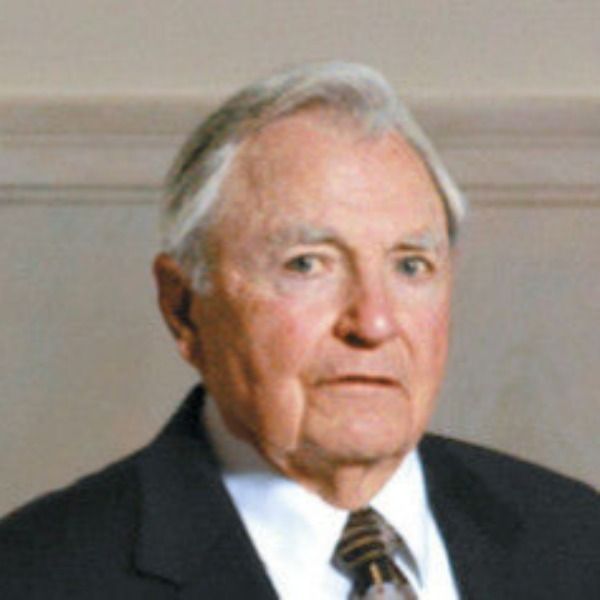
Rex Scouten
In 1969, he became Chief Usher, a position he held until 1986 when he briefly retired after 37 years of public service. At that time he was presented with the President's Award for Distinguished Federal Civilian Service by President Reagan in an Oval office ceremony. He returned to the White House at the request of President Reagan in 1986 as Curator. In this present position, Mr. Scouten is responsible for the White House collection of fine and decorative arts and the continuing research on the history and furnishings of the Executive Residence.
While assigned to President Truman's detail, Scouten was entering the White House's West Wing when the alarm came about the assassination attempt against President Truman by two Puerto Rican nationalists. Within minutes he was across the street at Blair House. During his assignment with then Vice-President Nixon, he traveled to forty countries. As Deputy to the Chief Usher, he was on duty when President Eisenhower suffered his slight stroke. During the Kennedy administration he assisted Jacqueline Kennedy with the now legendary dinner for Pakistani President Ayub Kahn held at Mount Vernon. Scouten was supervising the redecoration of the Oval Office when word came that President Kennedy had been shot. He put the office back in order later that evening and helped make arrangements for the state funeral and for the visiting world leaders. He did not leave the White House for five days during this period. As Assistant Regional Director for White House Liaison, he made significant contributions to Lady Bird Johnson's beautification program and strengthened the National Park Service's role in historic preservation and interpretation at the White House.
During his tenure as Chief Usher, the most elaborate dinner of modern times was given by the Nixons to celebrate the return of Vietnam POW'S. Nearly fourteen hundred people attended the party on the South Lawn and Scouten's crew laid out forty thousand items for table settings alone. In the Ford administration, Scouten played a role in the numerous state visits honoring our nation's two hundredth birthday. When President Carter restricted his public appearances because of the American hostage crisis in Iran, he helped bring the country to President Carter. There were 377 public events in the White House that year, the most in history. Scouten was in the White House Solarium with Mrs. Reagan when a Secret Service agent hurried in and he heard the dreaded words for the second time "The President has been shot".
Throughout his career he has traveled to over forty five countries, planned and supervised major ceremonies of state, in happy times and sad, and carefully watched over the development of the formal gardens and grounds of the White House as well as the preservation of the residence and work place of the President of the United States. In his present post as Curator, Scouten provides continuity, experience and affection to the everyday life of the White House.
Scouten's awards include: The President's Award for Distinguished Federal Civilian Service, The George McAneny Award, American Historical Preservation Society. He is an honorary member of the American Institute of Architects, Regent Emeritus of the American Architectural Foundation, a twenty five year member of the Committee for the Preservation of the White House, a board member of the Wolf Trap Foundation for the Performing Arts, the Association of Former Agents of the United States Secret Service, Historic Fairfax City, Inc., and the Very Special Arts Gallery Advisory Board.
In his lectures, Rex Scouten enjoys presenting the rich architecture, design and history of the White House and its collection of fine and decorative art to audiences around the world. When queried about plans of retirement he comments, "The White House is the most exciting place in the world. When I no longer get a thrill when I walk through those gates in the morning, I will know it is time to leave.”
In 1969, he became Chief Usher, a position he held until 1986 when he briefly retired after 37 years of public service. At that time he was presented with the President's Award for Distinguished Federal Civilian Service by President Reagan in an Oval office ceremony. He returned to the White House at the request of President Reagan in 1986 as Curator. In this present position, Mr. Scouten is responsible for the White House collection of fine and decorative arts and the continuing research on the history and furnishings of the Executive Residence.
While assigned to President Truman's detail, Scouten was entering the White House's West Wing when the alarm came about the assassination attempt against President Truman by two Puerto Rican nationalists. Within minutes he was across the street at Blair House. During his assignment with then Vice-President Nixon, he traveled to forty countries. As Deputy to the Chief Usher, he was on duty when President Eisenhower suffered his slight stroke. During the Kennedy administration he assisted Jacqueline Kennedy with the now legendary dinner for Pakistani President Ayub Kahn held at Mount Vernon. Scouten was supervising the redecoration of the Oval Office when word came that President Kennedy had been shot. He put the office back in order later that evening and helped make arrangements for the state funeral and for the visiting world leaders. He did not leave the White House for five days during this period. As Assistant Regional Director for White House Liaison, he made significant contributions to Lady Bird Johnson's beautification program and strengthened the National Park Service's role in historic preservation and interpretation at the White House.
During his tenure as Chief Usher, the most elaborate dinner of modern times was given by the Nixons to celebrate the return of Vietnam POW'S. Nearly fourteen hundred people attended the party on the South Lawn and Scouten's crew laid out forty thousand items for table settings alone. In the Ford administration, Scouten played a role in the numerous state visits honoring our nation's two hundredth birthday. When President Carter restricted his public appearances because of the American hostage crisis in Iran, he helped bring the country to President Carter. There were 377 public events in the White House that year, the most in history. Scouten was in the White House Solarium with Mrs. Reagan when a Secret Service agent hurried in and he heard the dreaded words for the second time "The President has been shot".
Throughout his career he has traveled to over forty five countries, planned and supervised major ceremonies of state, in happy times and sad, and carefully watched over the development of the formal gardens and grounds of the White House as well as the preservation of the residence and work place of the President of the United States. In his present post as Curator, Scouten provides continuity, experience and affection to the everyday life of the White House.
Scouten's awards include: The President's Award for Distinguished Federal Civilian Service, The George McAneny Award, American Historical Preservation Society. He is an honorary member of the American Institute of Architects, Regent Emeritus of the American Architectural Foundation, a twenty five year member of the Committee for the Preservation of the White House, a board member of the Wolf Trap Foundation for the Performing Arts, the Association of Former Agents of the United States Secret Service, Historic Fairfax City, Inc., and the Very Special Arts Gallery Advisory Board.
In his lectures, Rex Scouten enjoys presenting the rich architecture, design and history of the White House and its collection of fine and decorative art to audiences around the world. When queried about plans of retirement he comments, "The White House is the most exciting place in the world. When I no longer get a thrill when I walk through those gates in the morning, I will know it is time to leave.”