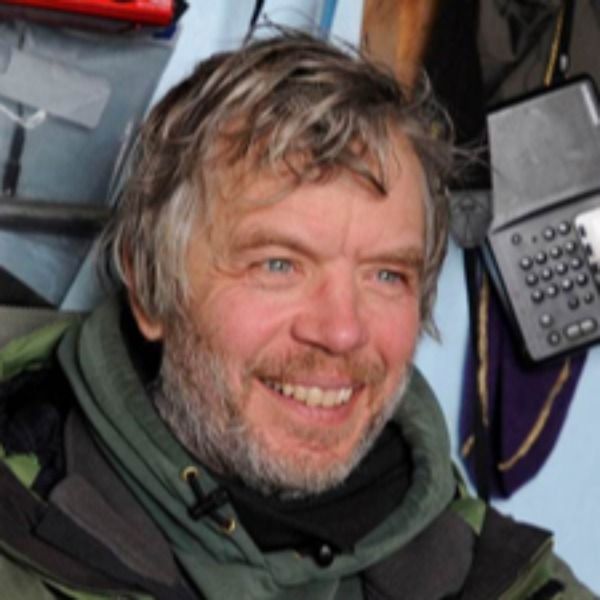
George Divoky has studied seabirds in Alaska since 1970 when, as a researcher at the Smithsonian Institution, he participated in the Coast Guard's survey of the Arctic Ocean adjacent to Prudhoe Bay. Since 1975, he has lived for three months alone every summer on remote Cooper Island, at the edge of the arctic pack ice, where his observations of Black Guillemots provide one of the best examples of a biological response to the reality of global warming in the arctic.
Divoky's research and his struggle to maintain a long-term study on a desolate arctic island were the focus of a New York Times Magazine cover story entitled "George Divoky's Planet" by Darcy Frey. (Frey is currently writing a book on Divoky due out in late 2006.) This major New York Times coverage in turn led to an appearance on Late Night with David Letterman as well as to being featured in the PBS series Scientific American Frontiers with Alan Alda.
His long periods of isolation from civilization in an environment rapidly changing from the impacts of that civilization have given him a unique perspective from which to view the early 21st century.
Denis Hayes, National Coordinator of the first Earth Day, described a recent presentation by Divoky as "hilarious, poignant, provocative, compelling. He held the crowd rapt, and left them at the end of the night much better educated, but without feeling like they'd heard a lecture."
Divoky obtained his doctorate from the University of Alaska Fairbanks where he now holds a position of Research Associate at the Institute of Arctic Biology. He is one of the founders of the Pacific Seabird Group, an international society of professional ornithologists and conservationists studying and protecting the marine birds of the Pacific Basin. He currently is director of "Friends of Cooper Island," a nonprofit dedicated to continuing his three-decade study and informing the public of his findings.
His presentations focus on understanding climate change and its impacts on arctic ecosystems. He provides audiences with well-documented evidence of climate change, but in addition he offers insights into the daily battle to survive next to the Arctic Ocean.
George Divoky has studied seabirds in Alaska since 1970 when, as a researcher at the Smithsonian Institution, he participated in the Coast Guard's survey of the Arctic Ocean adjacent to Prudhoe Bay. Since 1975, he has lived for three months alone every summer on remote Cooper Island, at the edge of the arctic pack ice, where his observations of Black Guillemots provide one of the best examples of a biological response to the reality of global warming in the arctic.
Divoky's research and his struggle to maintain a long-term study on a desolate arctic island were the focus of a New York Times Magazine cover story entitled "George Divoky's Planet" by Darcy Frey. (Frey is currently writing a book on Divoky due out in late 2006.) This major New York Times coverage in turn led to an appearance on Late Night with David Letterman as well as to being featured in the PBS series Scientific American Frontiers with Alan Alda.
His long periods of isolation from civilization in an environment rapidly changing from the impacts of that civilization have given him a unique perspective from which to view the early 21st century.
Denis Hayes, National Coordinator of the first Earth Day, described a recent presentation by Divoky as "hilarious, poignant, provocative, compelling. He held the crowd rapt, and left them at the end of the night much better educated, but without feeling like they'd heard a lecture."
Divoky obtained his doctorate from the University of Alaska Fairbanks where he now holds a position of Research Associate at the Institute of Arctic Biology. He is one of the founders of the Pacific Seabird Group, an international society of professional ornithologists and conservationists studying and protecting the marine birds of the Pacific Basin. He currently is director of "Friends of Cooper Island," a nonprofit dedicated to continuing his three-decade study and informing the public of his findings.
His presentations focus on understanding climate change and its impacts on arctic ecosystems. He provides audiences with well-documented evidence of climate change, but in addition he offers insights into the daily battle to survive next to the Arctic Ocean.
5 recomendar George
Publica tu propia reseña verificada cuando contrates a este orador a través de eSpeakers.
Earthday Network
In situ
D.H., Chairman, Earthday Network
He was simply perfect. He was hilarious, poignant, provocative, compelling. He held the crowd rapt, and left them at the end of the night much better educated, but without feeling like they'd heard a lecture. It was closer to a David Letterman monologue laced with serious content.
Whidbey Institute/Lyceum Lecture Series
In situ
J.P., Whidbey Institute/Lyceum Lecture Series
We have had nearly 50 fine speakers… and George Divoky ranks in the very top handful. He made the story of his 30+ years of research personal, exciting, clear, fascinating and occasionally lighthearted. A gripping story… environmental education at its finest.
Lafayette College
In situ
M.O., Williams Center Director, Lafayette College
An excellent presentation… compelling, with stunning photographs and humorous asides that kept the audience engaged… very well received. Students and even several long term faculty members commented that Dr. Divoky had given the best talk they had heard at Lafayette.
Portland Public Access TV
In situ
T.P., Videographer, Portland Public Access TV
Having seen George give a presentation… (his) humor and personality, along with his total commitment to his birds, come through… A presentation by George is a completely captivating experience.
The Nature Conservancy
In situ
S.D., Director, New York City Office, The Nature Conservancy
Your two presentations… served to engage and energize our Trustees, supporters and friends around the climate change issue. I still receive positive comments.