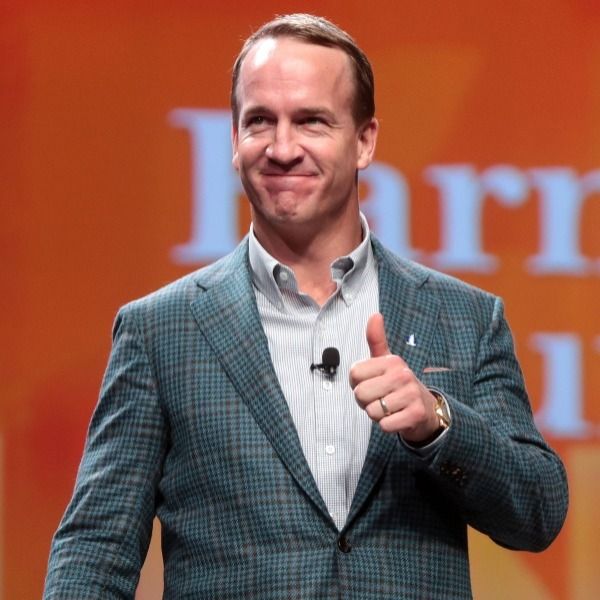
Peyton Manning
In his speeches, Peyton shares his insights on teamwork, leadership, motivation and his keys to success with audiences around the country.
Peyton Manning, starting quarterback for the Indianapolis Colts, may be on his way to becoming America's favorite male sports star. For years that honor was held by basketball legend Michael Jordan (1963–). But a January 2005 Harris poll surveyed American adults and found Peyton Manning nipping at Jordan's heels in the number-two spot. Sports analysts credited Manning's rise in popularity to his amazing performance during the 2004 football season. The six-foot-five quarterback broke several major National Football League (NFL) records, including most touchdown passes in a single season. As a result, Manning was honored with a slew of awards, including the NFL's Most Valuable Player prize for the second year in a row. In addition to being lauded for his abilities on the gridiron, Manning received numerous awards for his generous giving spirit. In April 2005 he was presented with the Byron "Whizzer" White Award, which, according to its official Web site, is given annually to the NFL player who "best personifies the spirit of service to team, community and country.
Peyton Manning was born on March 24, 1976, in New Orleans, Louisiana, the middle son of Archie (1949–) and Olivia Peyton. Peyton's father, Archie, was a celebrated football star, playing quarterback in college for the University of Mississippi and for various NFL teams during the 1970s and early 1980s, including the New Orleans Saints and the Minnesota Vikings. The elder Peyton went on to become a radio sports announcer for the Saints. When they were young, Manning and his brothers, Eli (1981–) and Cooper (c. 1974–), enjoyed tagging along with their father when the Saints were in town practicing during the off season. Sometimes the players and renowned coach Jim Mora (1935–) would even let the boys toss the ball around on the field.
While attending Isidore Newman High School in New Orleans, Peyton participated in a variety of sports. He was on the basketball team for two years and played shortstop on the baseball team. But football was his true passion—a passion he credits his father for instilling in him. Manning, however, is quick to note in interviews that Archie never pushed him into the sport. As he explained on his official Web site, "It was a policy in the house growing up, [Dad] would help us out and be glad to play catch with us ... but we had to go to him for help. He wasn't going to come to us and say, 'All right, you do this, you do that."'
Manning honed his skills by practicing with his brothers and neighborhood friends. He also spent hours listening to and
"I think that's why I have a love for football still today, because it was fun for me as a kid."
studying tapes of his father's old college and professional football games. By the time he was a sophomore at Isidore Newman, Manning was talented enough to be the starting quarterback; that same year his older brother, Cooper, was the team's wide receiver. The Manning boys became an inseparable pair both on the field and off, and worked so well together that the duo took their team all the way to the state Class 2A semifinals. Following his senior year Cooper accepted a scholarship to attend the college where his father played—the University of Mississippi, also known as Ole Miss. Unfortunately, during Cooper's freshman year, doctors discovered a spinal weakness, which caused a numbness in his legs and forced him to abandon his football career.
According to his brother, Cooper, who spoke with John Bradley of Sports Illustrated, "Peyton's got the potential to be one of the greatest quarterbacks of all time." Whether or not that is true is yet to be seen. The Colts, however, believed in him: In March 2004 they signed Manning to a $99.2 million, seven-year contract, which included an NFL-record $34.5 million signing bonus. Members of the Associated Press also believed in Manning, naming him the NFL's Most Valuable Player in both 2003 and 2004. Manning is only the third player in history to receive the award two years in a row. In addition, in 2005 the Colts' quarterback took home a number of other top honors, including The Sporting News Player of the Year Award and an ESPY for Best NFL Player. (ESPY awards are awarded to America's top athletes each year by the sports network ESPN.)
For Manning, however, the highest honor may have come in April 2005 when he was given the prestigious Byron "Whizzer" White Humanitarian Award, named for Supreme Court Justice and former NFL player Byron White (1917–2002). Established in 1967 by the professional football players of America, the prize acknowledges White's spirit of giving back to the community. "I am truly humbled by this honor," Manning remarked in a press release issued on July 20, 2005, "This means a lot to me because what I do off the field is much more important than anything I do on the field."
Manning's accomplishments off the field were truly impressive. In 1999 he created the PeyBack Foundation, the goal of which, according to Manning's Web site, "is to provide leadership and growth opportunities for children at risk." As of 2005 the foundation has donated over $900,000 to children's programs in Indiana, Tennessee, and Louisiana. The big-hearted Manning participates personally in the majority of the foundation's initiatives, including Peyton's Pals, which sponsors a series of monthly cultural and educational events for selected Indianapolis middle-schoolers. One of the most high-profile events is the PeyBack Classic, an annual event in which Indiana inner-city high school football players are invited to play ball at the Indianapolis RCA Dome. All proceeds benefit struggling high school sports programs.
In an interview with Sports Illustrated, Peyton commented, "I would like to leave some kind of unique mark on the game." Given his astonishing number of passing records, his amazing number of awards, and his generosity off the field, the young man who was born into football royalty and who, in 2005, was at the height of his career, already seemed to have left his mark.
In his speeches, Peyton shares his insights on teamwork, leadership, motivation and his keys to success with audiences around the country.
Peyton Manning, starting quarterback for the Indianapolis Colts, may be on his way to becoming America's favorite male sports star. For years that honor was held by basketball legend Michael Jordan (1963–). But a January 2005 Harris poll surveyed American adults and found Peyton Manning nipping at Jordan's heels in the number-two spot. Sports analysts credited Manning's rise in popularity to his amazing performance during the 2004 football season. The six-foot-five quarterback broke several major National Football League (NFL) records, including most touchdown passes in a single season. As a result, Manning was honored with a slew of awards, including the NFL's Most Valuable Player prize for the second year in a row. In addition to being lauded for his abilities on the gridiron, Manning received numerous awards for his generous giving spirit. In April 2005 he was presented with the Byron "Whizzer" White Award, which, according to its official Web site, is given annually to the NFL player who "best personifies the spirit of service to team, community and country.
Peyton Manning was born on March 24, 1976, in New Orleans, Louisiana, the middle son of Archie (1949–) and Olivia Peyton. Peyton's father, Archie, was a celebrated football star, playing quarterback in college for the University of Mississippi and for various NFL teams during the 1970s and early 1980s, including the New Orleans Saints and the Minnesota Vikings. The elder Peyton went on to become a radio sports announcer for the Saints. When they were young, Manning and his brothers, Eli (1981–) and Cooper (c. 1974–), enjoyed tagging along with their father when the Saints were in town practicing during the off season. Sometimes the players and renowned coach Jim Mora (1935–) would even let the boys toss the ball around on the field.
While attending Isidore Newman High School in New Orleans, Peyton participated in a variety of sports. He was on the basketball team for two years and played shortstop on the baseball team. But football was his true passion—a passion he credits his father for instilling in him. Manning, however, is quick to note in interviews that Archie never pushed him into the sport. As he explained on his official Web site, "It was a policy in the house growing up, [Dad] would help us out and be glad to play catch with us ... but we had to go to him for help. He wasn't going to come to us and say, 'All right, you do this, you do that."'
Manning honed his skills by practicing with his brothers and neighborhood friends. He also spent hours listening to and
"I think that's why I have a love for football still today, because it was fun for me as a kid."
studying tapes of his father's old college and professional football games. By the time he was a sophomore at Isidore Newman, Manning was talented enough to be the starting quarterback; that same year his older brother, Cooper, was the team's wide receiver. The Manning boys became an inseparable pair both on the field and off, and worked so well together that the duo took their team all the way to the state Class 2A semifinals. Following his senior year Cooper accepted a scholarship to attend the college where his father played—the University of Mississippi, also known as Ole Miss. Unfortunately, during Cooper's freshman year, doctors discovered a spinal weakness, which caused a numbness in his legs and forced him to abandon his football career.
According to his brother, Cooper, who spoke with John Bradley of Sports Illustrated, "Peyton's got the potential to be one of the greatest quarterbacks of all time." Whether or not that is true is yet to be seen. The Colts, however, believed in him: In March 2004 they signed Manning to a $99.2 million, seven-year contract, which included an NFL-record $34.5 million signing bonus. Members of the Associated Press also believed in Manning, naming him the NFL's Most Valuable Player in both 2003 and 2004. Manning is only the third player in history to receive the award two years in a row. In addition, in 2005 the Colts' quarterback took home a number of other top honors, including The Sporting News Player of the Year Award and an ESPY for Best NFL Player. (ESPY awards are awarded to America's top athletes each year by the sports network ESPN.)
For Manning, however, the highest honor may have come in April 2005 when he was given the prestigious Byron "Whizzer" White Humanitarian Award, named for Supreme Court Justice and former NFL player Byron White (1917–2002). Established in 1967 by the professional football players of America, the prize acknowledges White's spirit of giving back to the community. "I am truly humbled by this honor," Manning remarked in a press release issued on July 20, 2005, "This means a lot to me because what I do off the field is much more important than anything I do on the field."
Manning's accomplishments off the field were truly impressive. In 1999 he created the PeyBack Foundation, the goal of which, according to Manning's Web site, "is to provide leadership and growth opportunities for children at risk." As of 2005 the foundation has donated over $900,000 to children's programs in Indiana, Tennessee, and Louisiana. The big-hearted Manning participates personally in the majority of the foundation's initiatives, including Peyton's Pals, which sponsors a series of monthly cultural and educational events for selected Indianapolis middle-schoolers. One of the most high-profile events is the PeyBack Classic, an annual event in which Indiana inner-city high school football players are invited to play ball at the Indianapolis RCA Dome. All proceeds benefit struggling high school sports programs.
In an interview with Sports Illustrated, Peyton commented, "I would like to leave some kind of unique mark on the game." Given his astonishing number of passing records, his amazing number of awards, and his generosity off the field, the young man who was born into football royalty and who, in 2005, was at the height of his career, already seemed to have left his mark.